

The short answer
- Chorus was one of the first conversation intelligence tools. Since ZoomInfo bought it in 2021 it is sold inside ZoomInfo's packages, not on its own.
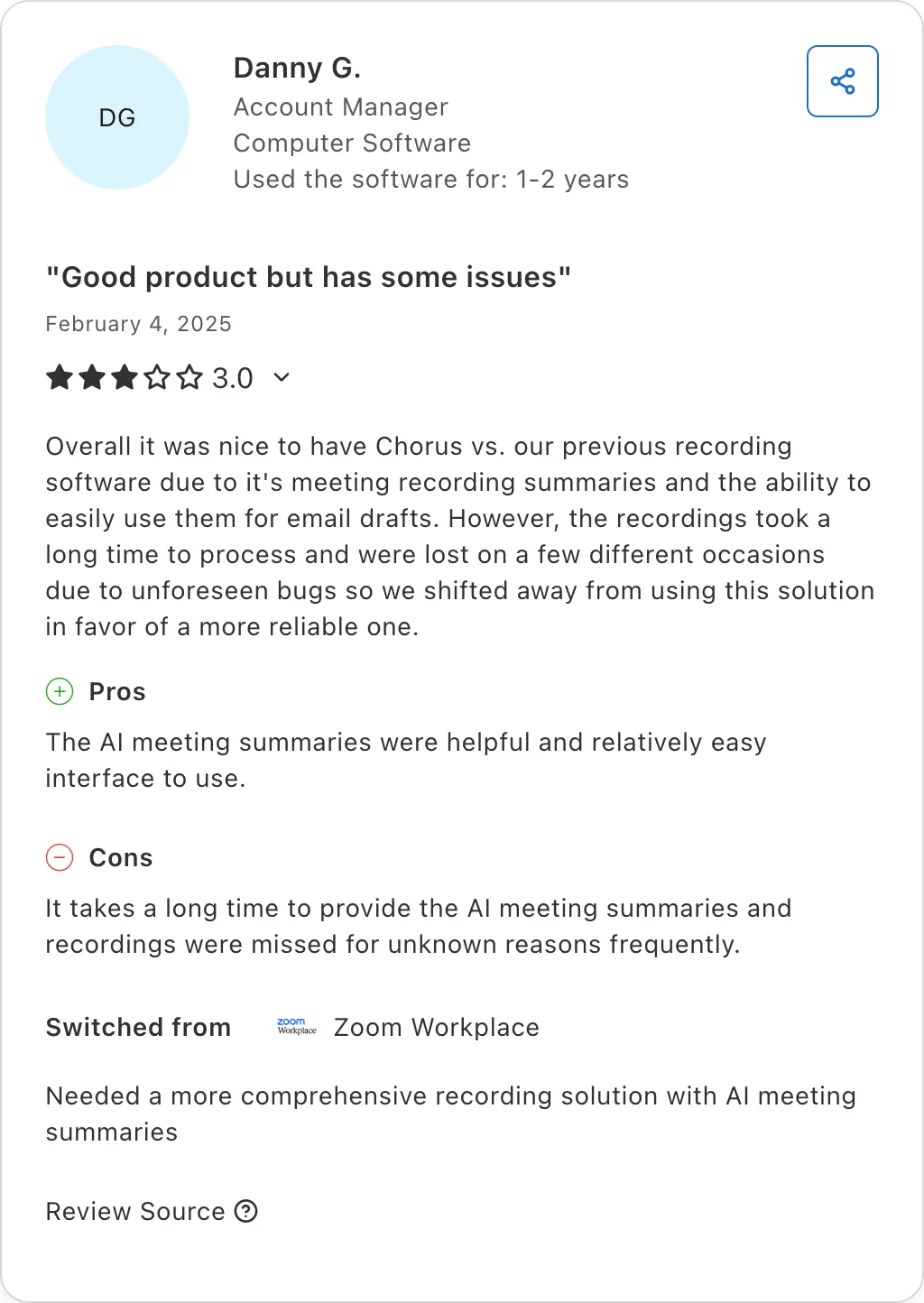
- It records and analyzes the call for people to review. Users say it gets expensive once the ZoomInfo contract is counted, and some report slow summaries and missed recordings.
- Bigmind records the call and then does the work that follows: the follow-up drafted, the deal assessed against your framework, the CRM updated and the promises turned into tasks. Every seat is free.
A pioneer, now a feature
Chorus helped define call recording for sales teams in the late 2010s. ZoomInfo bought it in 2021, and today chorus.ai redirects to ZoomInfo's site. Chorus has no plan of its own on ZoomInfo's pricing page; it is listed as a capability inside ZoomInfo's packages, and ZoomInfo's own product menu no longer names it.
Its pitch is the pairing: what was said on the call, next to everything ZoomInfo knows about the person and the company. If your team lives in ZoomInfo, that is genuinely useful.
Built for a different moment
Chorus was designed for a world where people did the work. It records the call, transcribes it, benchmarks talk ratios and filler words, and surfaces moments a manager might coach on. Then a person writes the follow-up, updates the CRM and remembers what was promised.
Language models changed what a call can produce. A transcript is now enough for software to draft the follow-up, fill in the qualification, flag the risk and assign the next step. None of the Chorus pages we read describe that kind of work, and its AI is described as transcription, trackers and a deal recommendation engine.
What Chorus customers say
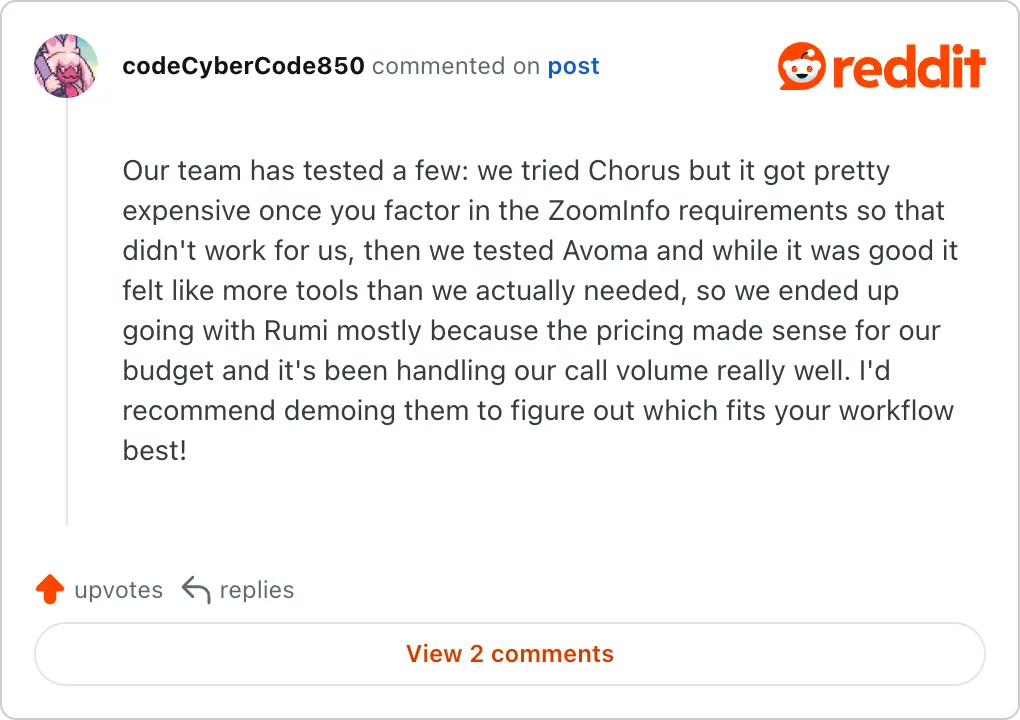
The complaint that comes up most is the price of the package around it:
Others describe a recorder they could not rely on. More is at the end of this page.
A recording nobody acts on is an expensive archive.
At a glance
| Bigmind | Chorus | |
|---|---|---|
| Built for | Agents doing the work a call creates | People reviewing recorded calls |
| Meeting capture | Google Meet and Microsoft Teams by bot or with no bot, in-person meetings on Mac, uploaded files, Aircall | Video calls, phone calls, emails, in-room meetings and a mobile app |
| After the call | Summary, follow-up drafted against your playbook, tasks for each commitment | Insights within minutes, shareable snippets |
| Qualification | Your framework, re-assessed from every call and email, with the evidence cited | Methodology adherence and a deal recommendation engine |
| Contact data | Enrichment from the providers you connect | ZoomInfo's database, built in |
| Pricing | By customers tracked, from €7,200 a year, unlimited free seats | Not published, inside a ZoomInfo package |
Where Chorus is still strong
ZoomInfo's data comes with it. A rep looking at a call also sees the contact's role, the company's size and the full relationship history.
Enablement. Benchmarks on talk-to-listen ratio, filler words and next steps, shareable snippets and ramp tracking for new hires.
Capture beyond the video call. Chorus separates several speakers on one microphone in the same room, records phone calls and has a mobile app.
What Bigmind does instead
The work is done when the call ends
When a call ends in Bigmind, the summary is on the deal, the follow-up is drafted against your playbook and every commitment is a task in the Inbox of the person who made it, with a date.

Your framework, not a generic score
Choose MEDDPICC, SPICED or your own. Bigmind fills in each deal from the evidence of every call, email and CRM change, and every field links to the meeting it came from. When a deal turns, the owner sees a warning with the reason, not only a risk score.


No data contract required
Chorus is easiest to buy if you already buy ZoomInfo. Bigmind works on its own, with Salesforce or HubSpot, and connects the data providers you already pay for, ZoomInfo included.
Their MCP, tool by tool
Every revenue tool now says it has an MCP server. What matters is what the tools let an agent do.
ZoomInfo's MCP server lists 26 tools, almost all for its contact and company data: search, enrich, intent, scoops and audiences. Chorus calls are reached through one of them, Conversation Intelligence. It answers a question about one engagement, company or contact from the five most recent transcripts and email threads, returns a written answer with citations, and costs around 10 AI credits a question. It reads; it does not update deals, the CRM or anyone's tasks.
Bigmind turns on 75 tools by default for every person, free seats included, and an admin can switch on 16 more groups. Across them, an agent can:
- Read the calls. Search every meeting your team has had and open any transcript.
- Read the deals. See where each deal stands against your framework, and which warnings are open.
- Do the work after a call. Create tasks, draft the follow-up email and add notes to the deal.
- Set Bigmind up. Change your qualification framework and the signals you watch for, from Claude.
- Update the CRM, with your approval. Changes to a deal's stage, amount or close date come back as a card to approve first.
What it costs
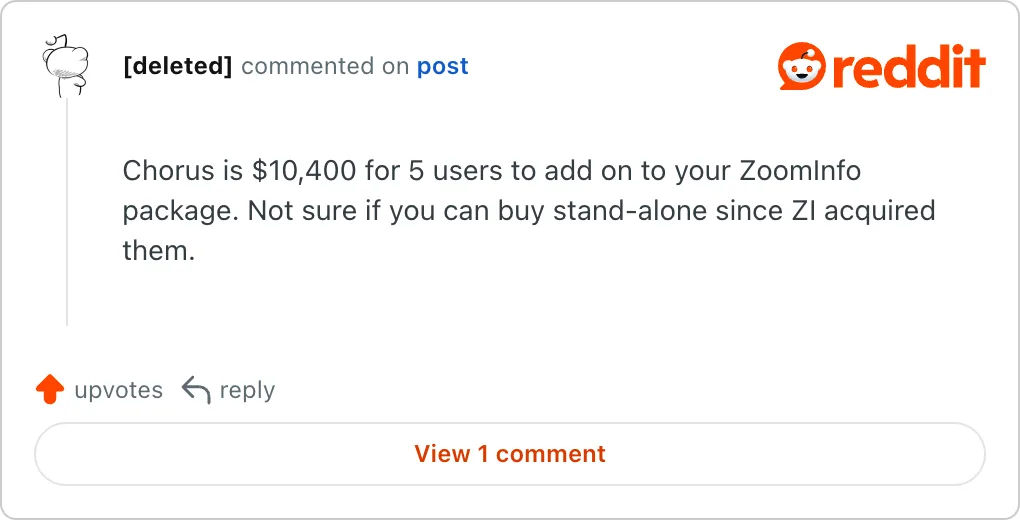
ZoomInfo does not publish prices, and Chorus is not sold as a plan of its own. One buyer on Reddit reported Chorus at $10,400 for five users as an add-on to a ZoomInfo package.
Bigmind publishes its prices. You pay for the number of customers your agents track, from €7,200 a year for 1,000 customers. Seats are free and unlimited. A person who needs a larger AI budget, or email and calendar sync, moves to Pro for €20 a month.
Which to choose
Choose Chorus if your team already runs on ZoomInfo and wants call analytics and coaching beside the contact data it uses every day.
Choose Bigmind if you want the call to update the deal, the CRM and each rep's task list without anyone typing, with or without a data vendor.
Moving from Chorus
Connect Salesforce or HubSpot, your email and your calendar, and Bigmind builds each account's record from what is already there. New calls are recorded from the first day. Scorecards and frameworks start from templates and are edited to your team's definitions. If you keep ZoomInfo for contact data, connect it as an enrichment provider.
Start a free trial or book a demo and we will walk you through it with your own accounts.
We wrote this from the Chorus pages and pricing page on zoominfo.com, and what Chorus users write on Reddit and Capterra, read on October 27, 2026. If something here is out of date, tell us and we will correct it.